
I Bought an $80,000 Truck — and I’m Using Options Trading to Pay for It
Apr 15, 2026
A while ago, I decided to try a simple experiment.
What would happen if I used one structured options strategy to make the payments on an $80,000 truck — and eventually pay it off entirely?
Not in theory.
Not in a backtest.
But in real life, using real trades.
So that’s exactly what I did.
What Results Can a Rules-Based Options Strategy Produce in Real Life?
Here’s where the experiment stands so far:
Starting account: $80,000
Current account balance (Feb 2026): $111,534
Total trading profit generated: $42,802
Truck payments made: $11,268
Return on starting capital: 53.5%
In other words, over the first six months, the strategy has already generated more than half the value of the truck in profits.
Is It Safe to Use Options Trading to Pay for Expenses?
Before going any further, I want to be very clear about something.
This is not a recommendation that anyone go into debt and try to trade their way out of it.
That would be irresponsible.
This experiment is simply a real-world example using a strategy I’ve traded for many years. The goal is to show what consistent, rules-based trading can look like over time.
Trading always involves risk, and results will vary.
Who Is Amy Meissner and What Is Her Trading Approach?
If we haven’t met before, I’m Amy Meissner.
I’ve been trading options full-time since 2006. Over the years, I’ve developed several structured options strategies designed to be:
- Market-neutral
- Rules-based
- Defined risk
- Manageable without sitting in front of a screen all day
Instead of trying to predict market direction, I focus on strategy structure, risk management, and repeatable execution.
Can Options Trading Be Used to Generate Monthly Income?
In August 2025, I financed a truck for approximately $80,000.
The payment is $1,878 per month, with 0% interest.
Instead of making those payments from my regular income, I opened a separate trading account with $80,000 and used one of my weekly options strategies to generate income from that account.
Each month:
- The truck payment is taken directly from the account
- Any additional profits remain in the account
- The results are tracked over time
The goal is simple:
Not to prove anything dramatic —
but to show what happens when a structured, rules-based strategy is applied consistently over time.
What Does a Structured, Rules-Based Trading System Look Like?
To keep the experiment clear and realistic, I set a few rules:
1️⃣ Start with $80,000
2️⃣ Use one core strategy
3️⃣ Track results consistently
4️⃣ Do not add additional funds
5️⃣ Pay the truck payment from the account
6️⃣ Allow remaining profits to compound
This removes variables and keeps the focus where it belongs:
On execution, discipline, and structure — not prediction.
What Were the Actual Results of This Options Trading Experiment?
Here are the account balances over time:
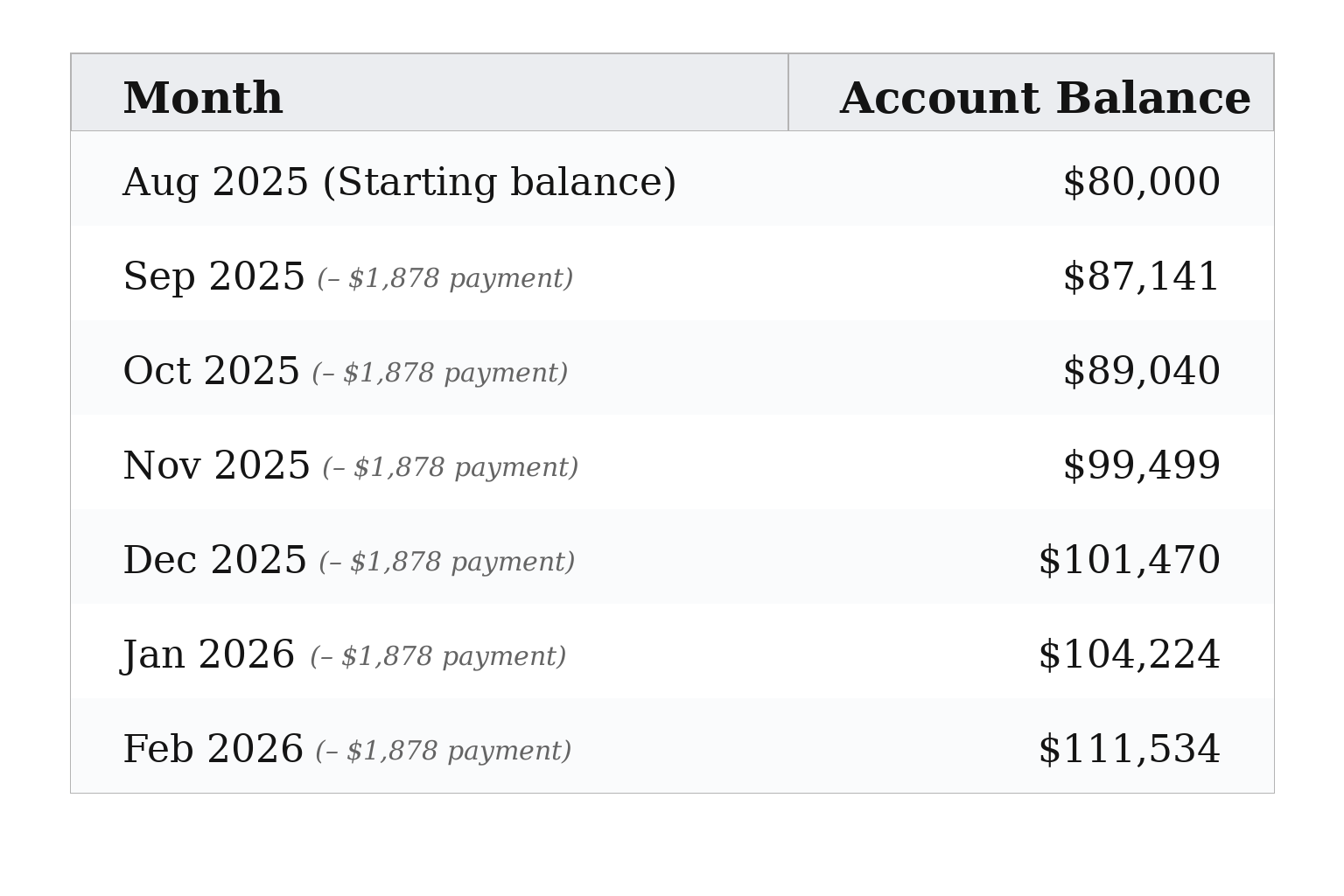
During this period:
- $42,802 in trading profits were generated
- $11,268 went toward truck payments
- The remaining profits stayed in the account and compounded
How Much Can a Weekly Options Strategy Generate in 3 Months?
At the end of the first three full months (November 2025):
Account balance: $99,499
Profit generated: $25,133
Truck payments made: $5,634
Return on capital: 31.4%
That means the strategy generated roughly 31% of the truck’s value in profit in three months.
What Happened After 6 Months of Consistent Trading?
After six months, the numbers look like this:
Starting capital: $80,000
Total profit generated: $42,802
Truck payments made: $11,268
Current balance: $111,534
Return on capital: 53.5%
So far, the strategy has generated more than half the value of the truck.
Can Options Trading Produce Consistent, Repeatable Income?
Most trading content focuses on:
- Large single trades
- Predicting market direction
- High-risk approaches
That’s not what this experiment is about.
What matters is whether a strategy can be:
- Repeated consistently
- Managed with clear rules
- Executed without emotional decision-making
This experiment demonstrates what happens when you remove guesswork and focus on:
structure, discipline, and repeatable execution.
Do You Need to Predict the Market to Be Successful in Options Trading?
No.
The strategy used in this experiment is designed to reduce reliance on market direction.
It focuses on:
- Structure over prediction
- Risk management over reaction
- Defined rules over intuition
This is what allows the strategy to be:
- Consistent
- Manageable
- Less emotionally reactive
What Strategy Was Used to Generate These Results?
This experiment uses a structured, rules-based weekly options strategy that focuses on:
- Defined risk
- Repeatable trade setups
- Clear management rules
- Consistency over time
It is not based on:
- Predicting direction
- Watching charts all day
- Constant trade adjustments
It is designed to be applied consistently — not reactively.
Want to See the Exact Strategy Behind These Trades?
If you’re curious how these trades are actually structured, I’ve put together a detailed breakdown of the strategy used in this experiment.
Inside, I walk through:
- How the strategy was developed
- The philosophy behind the system
- Why the broken wing butterfly structure was chosen
- The design and framework behind execution
- How trades are structured for weekly trading
- Examples from both the alert track record and the truck experiment
👉 Download the report: Click Here
If you prefer to go directly to the full workshop, you can explore it here:
👉 Click Here to explore the full Workshop
Will This Options Trading Experiment Continue?
Yes.
I’ll continue sharing updates as the experiment progresses.
Future checkpoints will likely include:
- 9-month update
- 12-month update
- Full payoff timeline
This is an ongoing example of what structured, rules-based trading can look like in real life.
Final Thoughts
Many traders believe consistent income from options trading requires:
- Constant screen time
- Predicting market direction
- Complex strategies
That’s not necessarily true.
With a structured approach, defined rules, and disciplined execution, options trading can become:
- More consistent
- More manageable
- More aligned with real life
That was the purpose behind this experiment.